

So here we are! It’s Tour time and another round of ‘can anyone get the better of Tadej Pogačar’? This is the most incredibly stacked and competitive Tour de France I can remember for a long time, with the emergence of several world class youngsters, and other top favourites arriving in fine form. Maybe that’s the rose tinted goggles talking and maybe I’ve been thinking this every year, but I genuinely think this’ll be a real slug fest. We’ll get to the riders in due course, but first up, the route!
The Route
I love how whenever I read a guide for a grand tour, every opinion states a slightly different variation of stages. I always wonder if they’ve seen something I haven’t, but in the end, this is just my interpretation of what characterises each stage. All in all, there are seven flat stages with five likely to be proper sprints and the other two could either go to a break or a reduced sprint. Or all seven go to a proper sprint. Four stages are punchy medium mountain stages, five are in the high mountains, and three more finish on proper summit finishes. Two of the high mountain stages do finish uphill as well, but one is a very long low gradient ascent, and the other is a tiny kick, so not true summit finishes in my book. On top of these road stages we have one team time trial and one individual time trial. Here are the key stages to watch out for complete with a profile or two.
Stage One: We open with a 19.6km team time trial in Barcelona where each rider is awarded their own time for general classification (GC) purposes.
Stage Two: We stay in Barcelona for a very punchy day ending in three laps around the Olympic park. It’s not quite the same finish as the end of the Volta a Catalunya, the climb is shorter and much steeper. A first chance for Pogačar to show his hand and for others to lay down a challenge.
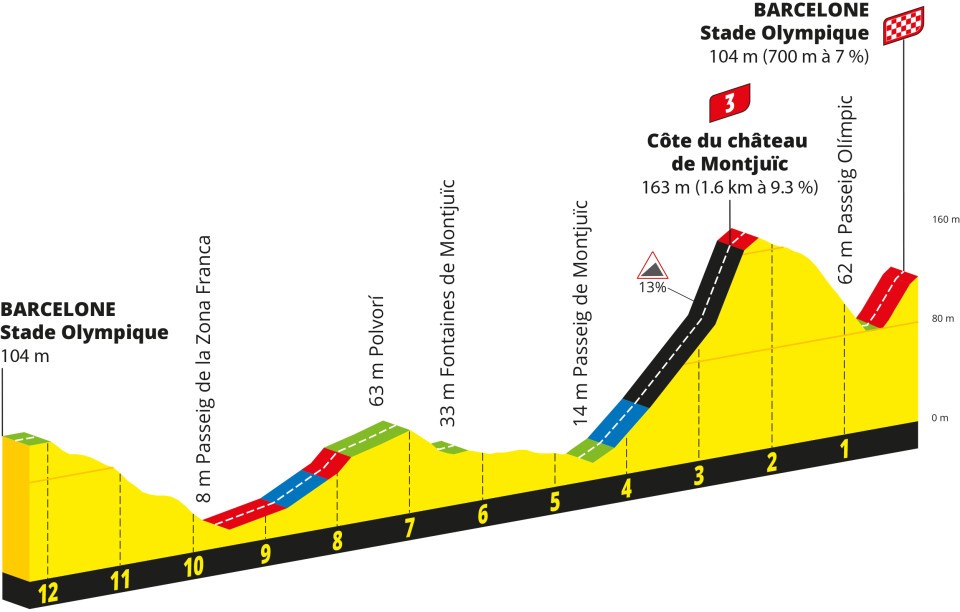
Stages Three and Four: Two early opportunities for the break, or a couple of nice reduced finishes. Stage three has a very enticing uphill finale, but stage four should go to the break.
Stage Five: The first sprint of the race.
Stage Six: The race goes over the Tourmalet leading to that long category two drag to the line that I mentioned earlier. Another possible early break stage.
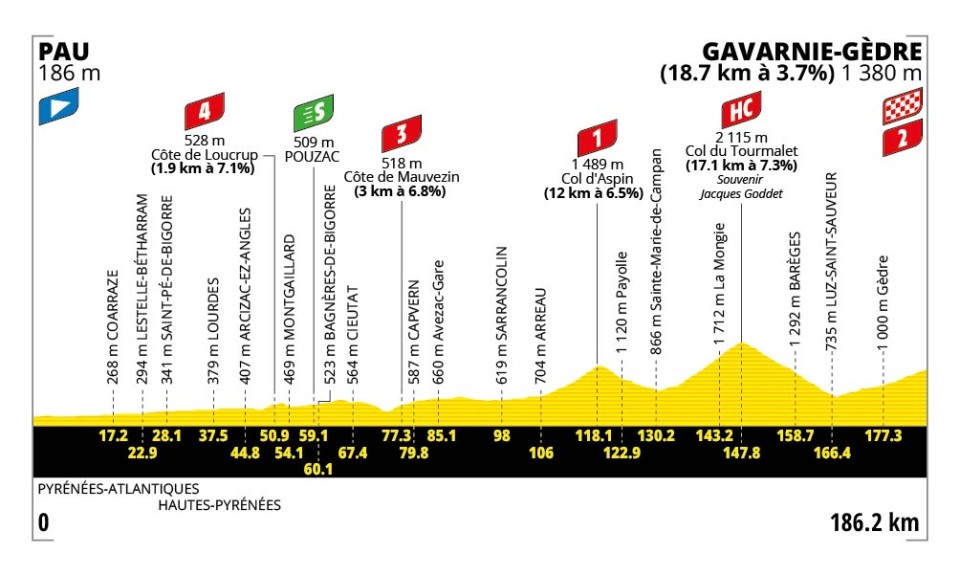
Stage Nine: A super fun stage with four categorised climbs ends week one.
Stage Ten: Week two starts as week one ended, with a really tough day for a break.
Stage Fourteen: The second of two hard days in the Alsace, and the one more likely to lead to GC action, but both will entice the break. Three category one climbs should spice up the King of the Mountains (KOM) competition too.
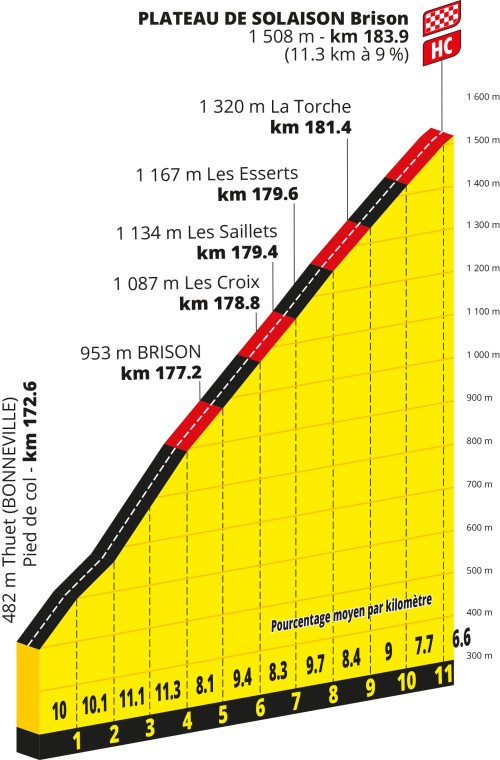
Stage Fifteen: A colossal summit finish brings the curtain down on the second week of racing. The 11.3km 9% Plateau de Solaison was used in the recent Auvergne – Rhône-Alpes where Del Toro beat Ayuso by a minute.
Stage Sixteen: The 26.1km individual time trial gets things going in week three. The stage features a short category two climb and descent next to the shores of Lake Geneva.
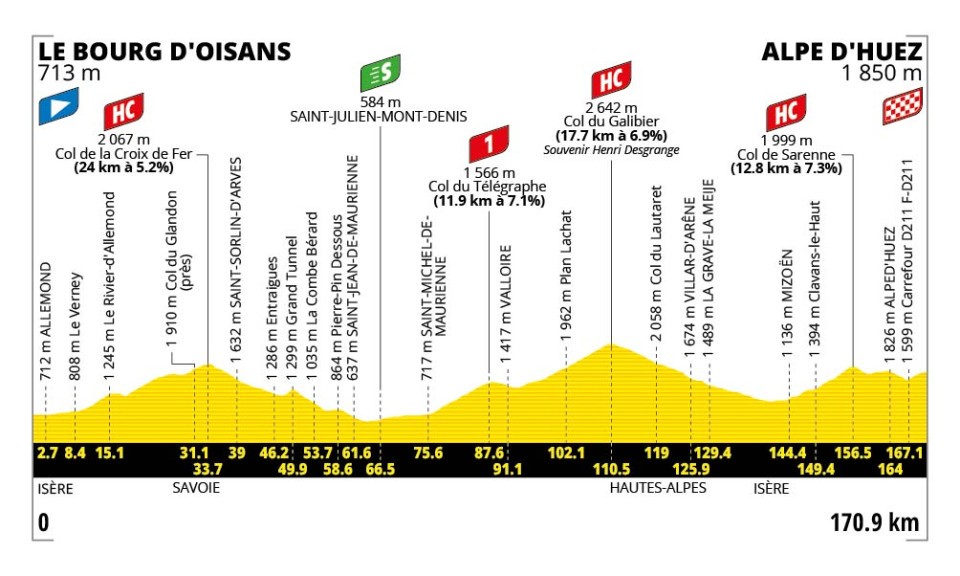
Stage Nineteen: The first of a double headed Alpine finale and this is the proper Alpe d’Huez summit finish 13.8km at 8.1%.
Stage Twenty: This is without doubt the Queen Stage and the only one with over 5000m of elevation gain. It finishes up the easier side of Alpe d’Huez, but not before the steep Col de Sarenne. Hopefully it’s a cracker.
Stage Twenty One: Montmartre is being kept in after last year’s excitement, but there’s slightly more room between the final climb and the finish that should bring the sprinters back into play.
Velogames Category Guide
So now we move onto the main course of this evening’s entertainment and I’ve written notes about basically everyone. Well I’ve still done a selection from the unclassed and the 6 credit climbers, and I haven’t done the 6 credit sprinters, but I will talk about one or two. I’ll also bring everything together at the end with some selection advice, but I have no idea what that will be at this point in time. Hopefully me covering the riders in some detail will open my eyes to the right play. Anyway! On with the show.
All Rounders
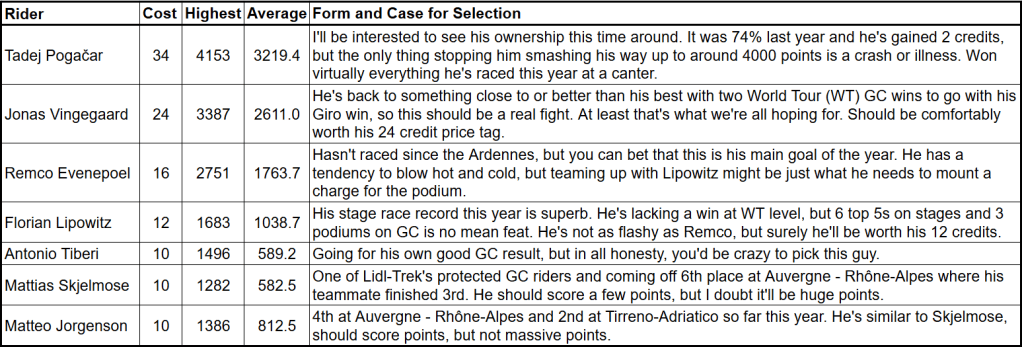
These are all your main hitters in the all rounder category. 58 credits for the two main favourites this time around, and whilst that was the play a year ago, will that pay off for you two years in a row? I’m tempted to do what I should have done last time around and just pick Pogačar and Lipowitz, but can you leave out Pogačar? Or can you pair him with one of these potential bargains?
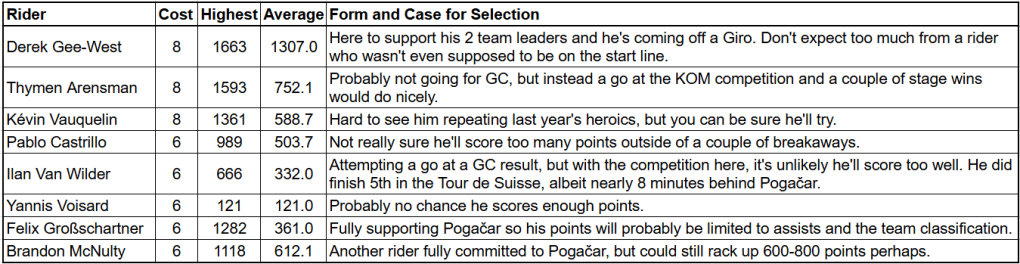
A few interesting options down in the cheap seats including McNulty for some free UAE related points. Elsewhere are the Ineos duo of Arensman and Vauquelin, or the GC hopeful for Quick-Step in Van Wilder.
Climbers
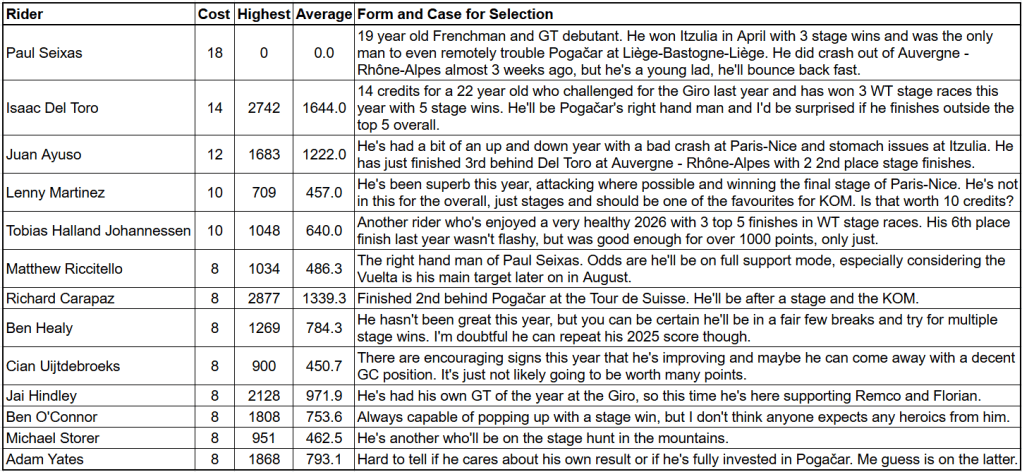
Once again the climbers category is absolutely stacked with potential. Seixas is the most expensive climber since Sepp Kuss at the 2024 Vuelta a Espana and provides some good competition to the expensive all rounders on offer. Hard to pair him with Pogačar, but could be a good companion to Vingegaard!
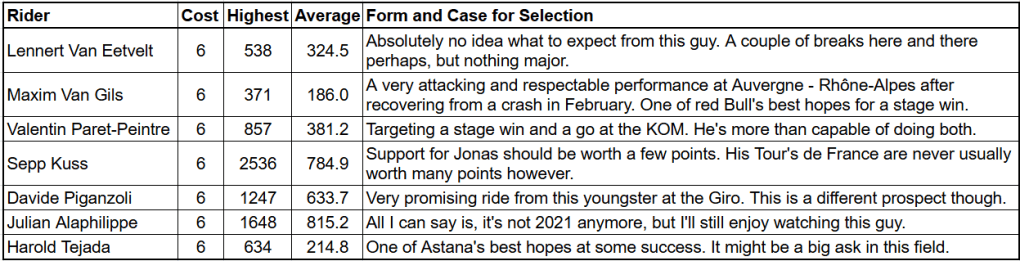
Not too many options for 6 credits, but these are the best looking ones to me. I’m currently not planning on taking any of these guys, but never say never.
Sprinters
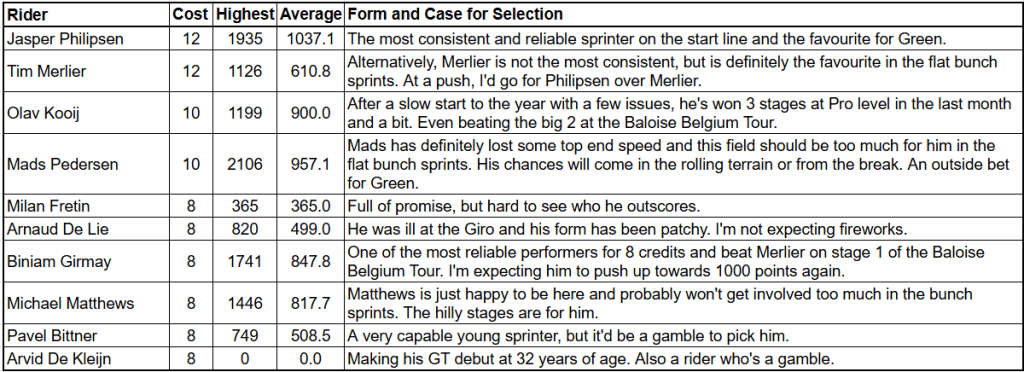
There are your main sprinters and I’m tempted by three riders here, Philipsen, Kooij, and Girmay. For even cheaper than this lot you can have Phil Bauhaus, Alex Aranburu, Pascal Ackermann, and Max Kanter. The best of that selection may be Kanter, and perhaps you’ll have to take a 6 credit sprinter if you stack the rest of your team. I’m trying not to do that, but it depends where my mind wanders off to between now and Saturday.
Unclassed
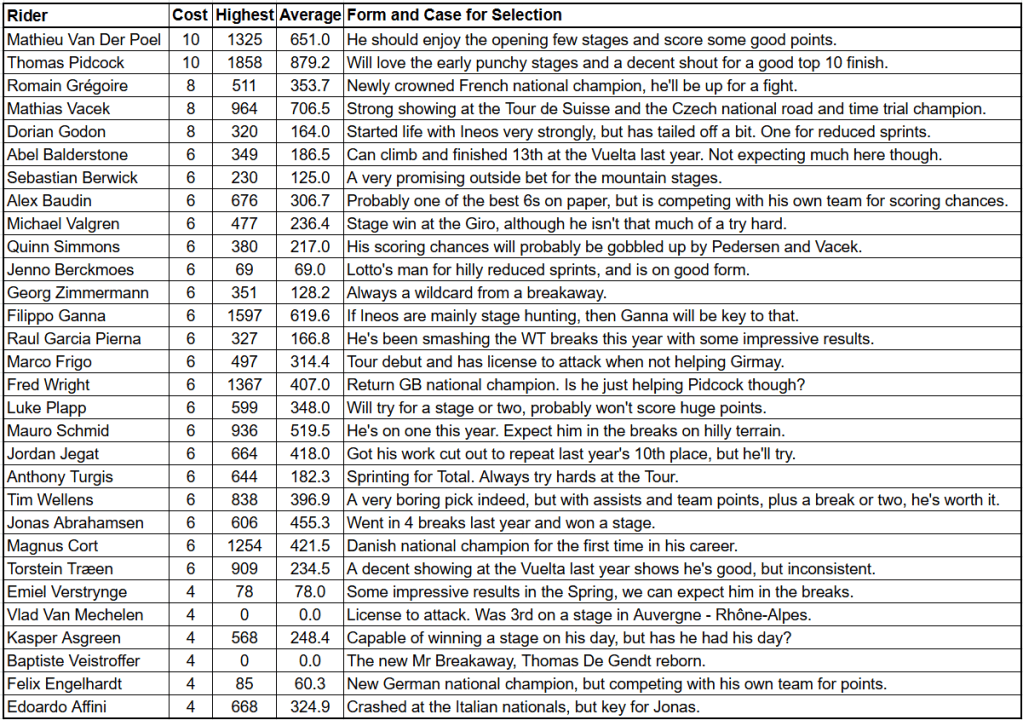
These are my picks for the unclassed and in a lot of the scheming I’ve been doing with my friends, we’ve been forced to take at least two 4 credit riders because we’re stacking so top heavy. Again I’m going to try my best not to lock me out of a decent trio of unclassed riders, but I’m not sure how to do that yet.
Selection Advice
Last year I was one of the intrepid few who was enticed by the prospect of triple stacking Vingegaard, Evenepoel, and Roglic, but alas, it didn’t pay off. This year, in addition to two of those riders, we have Seixas and Del Toro to throw in the mix. It’s more possible than ever to build a team without the big man. My main advice would be to not neglect any area of the team. You still want some balance, whilst taking who you like and think will score well. I have a quartet of all rounders and climbers in mind, but I can’t shake the feeling that at least one of them won’t score very well. Does the presence of so many top level riders limit the chances for the breaks? I will tell you now, the only rider I’m sure will be in my team is Isaac Del Toro. He’s too good for 14 credits. The other 8 spots are all up for grabs.
Here’s a reminder of the league code for those not yet in it: 649949130. We’ve been very successful as a league in the women’s game, but now’s the time for a grand tour win in the men’s.


Great write-up thanks! I have a feeling it will be a very interesting year, and hard to make the right picks.
Do you think the adaptee TTT format will play a big role?
Thoughts on Vinokurov or Van Mechelen?
LikeLike
I’ve added some thoughts on Van Mechelen, he’s an interesting shout. Astana are hard to figure out, so Vinokurov would be a gamble, but a fun pick!
LikeLike