
The 2019 Vuelta a España route will take 176 riders from the Mediterranean coast in the south of the Valencian Community, through 21 grueling and often treacherously steep stages until we reach the finale in Madrid. Here I will summarise the route; which stages to watch out for; where the race might be one or lost; and there may be some room to highlight the most bonkers climbs along the way.
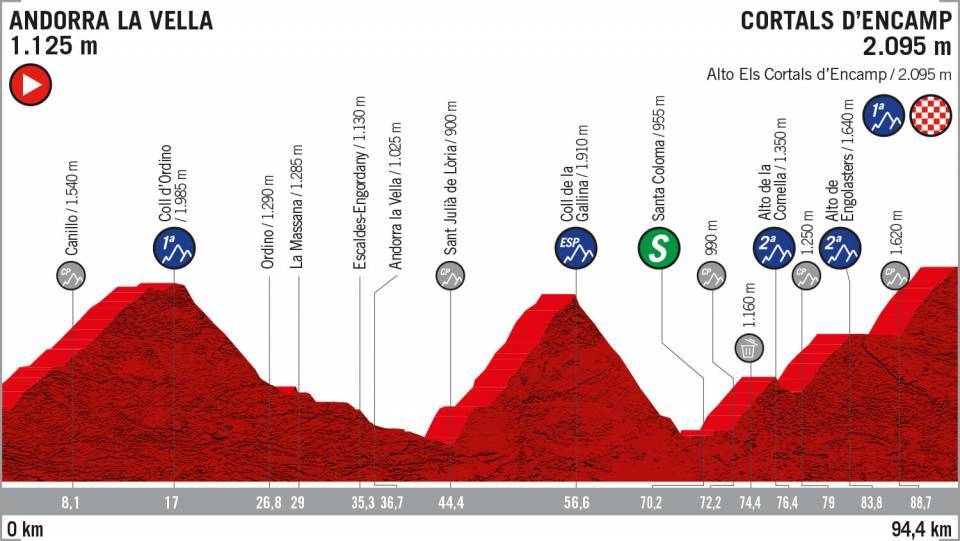
The route initially heads north through some hilly and flat stages before back to back to back summit finishes in the mountains northwest of Valencia. The fun of the opening week doesn’t stop there! After a transitional hilly stage near Barcelona, the riders will tackle one of the standout stages of the race, a monstrous mountain stage in Andorra. A short stage, but one that crests two giant cols, before a finish at Cortals d’Echamps over 2000m up.
Week 2 starts with the only individual time trial of the race followed by three difficult hilly stages and two more mountain top finishes (you can start to notice a theme here) through the mountainous regions of the Basque Country, Cantabria, and Asturias. Week 3 kicks off with yet another mountain top finish, this time racing in the mountains that surround Madrid, before two hilly stages and two more mountain stages round out the race. And of course, the customary sprint finale in Madrid itself.

Main talking points
Well the first thing to consider, is why any sprinters would bother turning up to this race. It’s hardly the grand tour best suited to sprinters at the best of times, but this year’s route does seems a tad lean on opportunities for the fast men. The official La Vuelta website lists six stages as flat, I have it down as five potential sprints and that’s not exactly guaranteed! Stage 14 is a particular example of a stage ‘suited’ to the sprinters, but it immediately follows one of the toughest finishes of the race and precedes two more of the toughest. If I were to stick my neck out, I’d say there will be four sprint finishes on stages 3, 4, 17, and 21. We’ll have to wait and see if the teams are up to the chase.
The second point of note, is that this route massively favours breakaway victories. Not that the race hasn’t before (there were eight breakaway wins last year), but this years parcours does seem to scream breakaway. I can see potential almost everywhere, and we might see a repeat of the eight wins from last year or a couple more.
Lastly, the organisers have packed this edition with uphill finishes, again, not that they don’t in other years. I count eight really tough summit finishes and numerous others that finish up shorter rises, punchier finishes if you will. I will highlight some of the key stages to look out for below.
Key stages
Stage 5: L’Eliana › Observatorio Astrofísico de Javalambre
The first major summit finish and the first potential shake up in the general classification (GC), after the team time trial of course. It’s still early doors here, but any potential winners will be keen to lay down an early marker. The final climb is 10.9 km at 8%, but the final 5 km barely goes below 10%. It’s a climb with a sting.
Stage 9: Andorra la Vella › Cortals d’Encamp
At only 96.6 km in length, it’s not a long stage, but there’s hardly a metre of flat. The opening climb is not that taxing, but the Coll de la Gallina is. It is the first of three HC classified climbs of the race, 12.1 km long with an average gradient of 8.4%. There will be some big gaps on this stage, and the potential for riders who aren’t such fans of the mountains to miss the time cut.
Stage 10 (ITT): Jurançon › Pau
The only individual time trial of the race arrives immediately after the first rest day. At 36.1 km long, it’s no monster, but it does roll over a couple of short and sharp climbs. Whoever wins here will be good on all terrain in a similar fashion the the stage 13 time trail at this year’s Tour de France. A brief look at the start list tells me Primož Roglič is the favourite for this one.
Stage 13: Bilbao › Los Machucos. Monumento Vaca Pasiega
Here we see the 2nd HC climb, but this time it comes at the finish. The final 6.5 km averages 10.4% with early ramps over 20% and the final 4 km is consistently in the mid to high teens. The rest of the stage is hardly flat either, with three category 2 and three category 3 climbs for the riders to enjoy.
Stage 18: Colmenar Viejo › Becerril de la Sierra
This is a classic ‘shark’s tooth’ profile of a stage that goes over four long and tough climbs. It’s not that they’re the hardest climbs of the race by any means, just that there’s no respite at all. It’s stages like this, placed deep into a grand tour, where riders can really become undone. It’s what happened to Tom Dumoulin in 2015, his breakout grand tour, leading the race into stage 20 when it all went pear-shaped.

I believe that whoever’s in the lead after stage 18 will go on to win. Granted, there’s still stage 20 to contend with, but I don’t think it’s sufficiently hard enough to put anyone in serious difficulty. If the leader of the race can survive stage 18, then they can survive stage 20. It’s never quite that simple in a grand tour though.
Stay tuned for a Velogames Fantasy Cycling game preview, and if you don’t want to miss another update, then subscribe for email alerts. See you next time!
(Profiles as seen on La Vuelta and other information from PCS)

 The Pelotonian